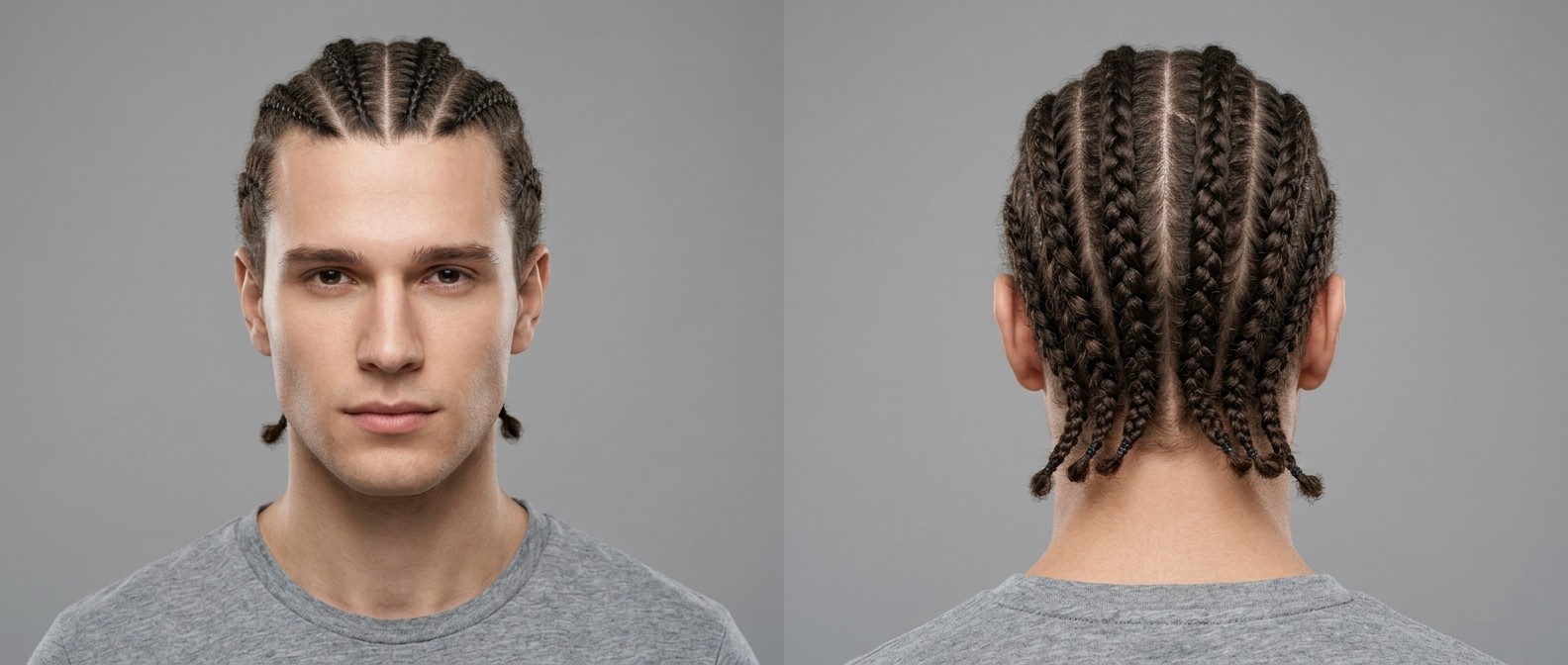
Add one front-facing photo. We send it to the AI together with this exact cut — and you get a photorealistic preview of yourself wearing it.
1
Your photo
Front view · neutral face · even light
2
This haircut
Already included
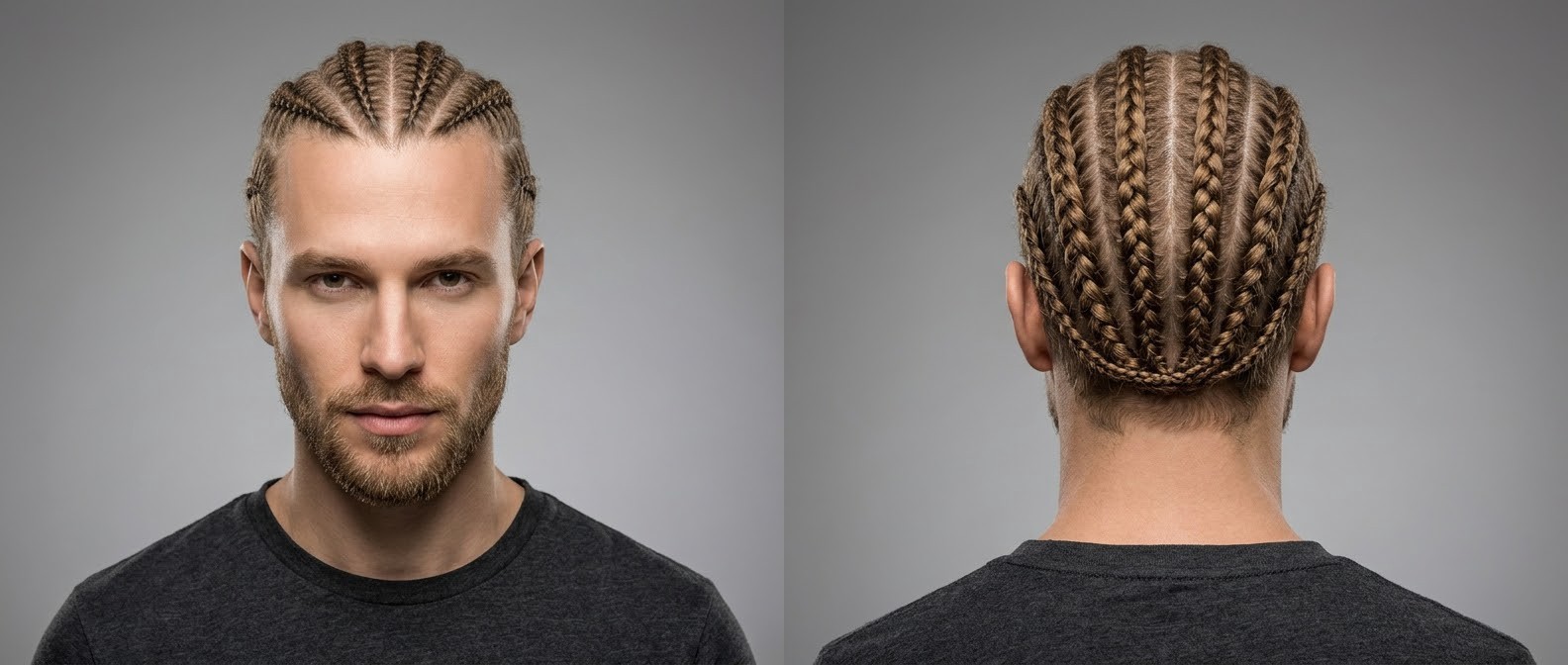
Front and back reference — taken from this page
3
Your preview
Your result appears here
![]()
![]()
Generated for you, not published anywhere
How do you rate this tool?
- Reading your photo
- Matching the cut
- Rendering your preview
How to take a photo that works
Do
- Face the camera straight on
- Even daylight, no harsh shadow
- Head and shoulders in frame
- Hair fully visible, nothing covering it
Avoid
- Hats, caps, hoods, sunglasses
- Steep angles or a tilted head
- Group photos or heavy filters
- Backlight that darkens the face
Symmetrical Straight-Back Cornrows for Thick Curly Men's Hair
 Top
Long (10-20 cm)
Top
Long (10-20 cm)
 Sides
Medium (2-5 cm)
Sides
Medium (2-5 cm)
 Hair Type
Curly (Type 3)
Hair Type
Curly (Type 3)
 Face Shape
Rectangular
Face Shape
Rectangular
 Maintenance
Medium
Maintenance
Medium
 Thickness
Thick / Dense
Thickness
Thick / Dense
About This Style
This striking variation of straight-back cornrows offers a remarkably clean, geometric aesthetic that beautifully manages thick, Type 3 curly hair. By parting the hair into six perfectly symmetrical, vertical sections, this style provides a highly organized and polished look from every angle. The dark brown hair is braided tightly against the scalp, starting from a crisp, straight natural hairline and extending smoothly down past the nape of the neck, ultimately ending in secure, looped tips. It is a fantastic protective style that takes the daily hassle out of managing dense, long hair while keeping your strands safe from environmental damage and mechanical manipulation.
If you have a rectangular face shape and a strong jawline, the vertical lines of these braids perfectly complement your bone structure by drawing the eye lengthwise and creating a balanced silhouette. It is an exceptionally practical choice for an active, casual lifestyle, requiring virtually zero daily styling time once the braids are installed. Whether you are hitting the gym for a heavy workout, heading to college classes, or just going about your everyday routine, this low-maintenance yet visually impactful look ensures your hair stays completely out of your face while making a bold, confident statement.
If you have a rectangular face shape and a strong jawline, the vertical lines of these braids perfectly complement your bone structure by drawing the eye lengthwise and creating a balanced silhouette. It is an exceptionally practical choice for an active, casual lifestyle, requiring virtually zero daily styling time once the braids are installed. Whether you are hitting the gym for a heavy workout, heading to college classes, or just going about your everyday routine, this low-maintenance yet visually impactful look ensures your hair stays completely out of your face while making a bold, confident statement.
Key Features
- Six perfectly symmetrical, thick straight-back braids running vertically from the front natural hairline all the way down to the nape of the neck.
- Crisp, highly visible scalp partings that create a striking geometric contrast against the density of the dark brown hair, highlighting the precision of the cut.
- Tightly woven underhand braiding technique, generally known as cornrows, that allows the plaits to sit raised and prominently on the surface of the scalp.
- Clean, squared-off natural hairline that anchors the front of the style elegantly without the need for heavy, artificial-looking edge control products.
- Braids extending 10 to 20 centimeters in length, finishing uniformly in small, looped-back ends that are secured with discrete, snag-free black elastics.
- Exceptional tension control that gathers dense, Type 3 curly hair into smooth, uniform plaits, eliminating frizz and controlling volume effectively.
Getting the Cut
- Request a thorough detangling and professional blow-out of your thick, Type 3 curly hair to prepare a completely smooth, stretched base for the braiding process.
- Ask the stylist or braider to section your hair into exactly six even, vertical columns running perfectly parallel from the front hairline straight back to the nape of your neck.
- Specify that you want traditional straight-back cornrows using an underhand braiding technique, ensuring the braids sit raised off the scalp rather than flat.
- Instruct them to maintain firm but comfortable tension to ensure the braids are neat, uniform, and secure without causing traction alopecia, headaches, or scalp irritation.
- Ask for the natural, straight hairline to be kept clean and sharp, avoiding excessive edge control, artificial enhancements, or pushing the hairline back.
- Request that the ends of the braids, which should hang about 10 to 20 cm long, be folded back into small loops and secured tightly with small, snag-free black elastic bands to prevent unraveling.
- Explicitly mention that you want the scalp partings to be razor-straight and clearly defined, as this emphasizes the bold geometric look of the overall style.
Daily Routine
- Wake up and carefully remove your silk or satin durag or bonnet, which is an absolute essential step for protecting the braids overnight and preventing friction.
- Take a few seconds to visually inspect the braids and scalp partings, gently patting down any minor flyaways that may have surfaced during your sleep cycle.
- Apply a very light mist of a hydrating scalp soothing spray, or plain water infused with a drop of tea tree oil, directly to the exposed scalp partings to refresh the skin.
- Dispense a dime-sized amount of lightweight hair oil or a specialized braiding mousse into your palms, rub them together, and gently glaze the product over the surface of the cornrows to restore natural shine.
- Strictly avoid rubbing, scratching, or heavily massaging the braids themselves, as this friction will create unwanted frizz and significantly shorten the lifespan of the protective style.
- Check the small elastic bands at the ends of your braids to ensure the looped tips are still secure and intact, gently adjusting them if any have slipped down during the night.
- You are completely ready for the day; this highly efficient protective style requires under one minute of actual morning maintenance to look exceptionally fresh, polished, and put-together.
Products & Tools
- Professional rat-tail comb with a fine metal pin, essential for creating razor-sharp, precise scalp partings between each braid section.
- High-quality detangling brush or a sturdy wide-tooth comb for thoroughly prepping and detangling the thick, curly hair before the braiding process begins.
- Lightweight, non-flaking braiding gel or a minimal-hold edge control to provide essential grip, smooth down flyaways, and keep the roots neat during installation.
- Snag-free, small black elastic bands specifically designed for hair, used for securing the looped ends of the braids without causing breakage.
- Hydrating scalp spray or a lightweight natural oil blend, such as jojoba or sweet almond oil, to moisturize the exposed scalp and prevent dry flaking.
- Premium silk or satin durag, or a high-quality sleep bonnet, to completely protect the style from damaging friction against cotton pillowcases while sleeping.
Maintenance
- Schedule a professional takedown and re-braiding appointment every 3 to 4 weeks to prevent severe hair matting at the roots and to maintain crisp, neat partings.
- Wear a high-quality silk or satin durag every single night without fail to prevent friction, lock in essential moisture, and stop the braids from developing premature frizz.
- Cleanse your scalp weekly using a witch hazel-soaked cotton pad or a specialized dry shampoo mousse designed specifically for braids, actively avoiding heavy water washing which causes frizz.
- Apply a few drops of lightweight scalp oil every two to three days directly to the exposed parted areas to prevent flaking, dryness, and soothe any mild tightness.
- Never leave the braids installed for longer than a month, as your natural new hair growth can cause the base of the braids to tangle, lock up, and ultimately break during removal.
Best For
Men with thick, dense Type 3 curly hair that requires a reliable, long-term protective style to manage volume and prevent daily mechanical damage.
Rectangular and square face shapes, as the strong vertical lines of the straight-back braids perfectly complement and highlight strong, masculine jawlines.
Highly active individuals, gym-goers, and athletes who need their long hair entirely secured, sweat-managed, and kept completely out of their face during rigorous movement.
Younger demographics, particularly men ages 18 to 25, who are looking for a highly stylish, culturally significant, and casual everyday look.
Anyone seeking the ultimate low-maintenance morning routine that literally takes under one minute of styling time before walking out the door.
Pro Tips
- Always ensure your hair is thoroughly washed, deep-conditioned, and blow-dried straight before braiding; stretching the curls makes the braiding process much smoother and the final result significantly neater.
- Communicate with your braider to ensure they do not pull the hair too tight at the delicate front hairline; excessive tension in this area is the leading cause of receding hairlines and permanent traction alopecia.
- If your scalp feels itchy or irritated in the first few days after installation, strictly resist the urge to scratch with your fingernails; instead, lightly pat the area or use a soothing peppermint oil spray.
- To notably extend the pristine life of your braids, securely tie them down with a durag or sweatband before engaging in high-intensity workouts to minimize frizz caused by excessive sweat and movement.
Related Hairstyles
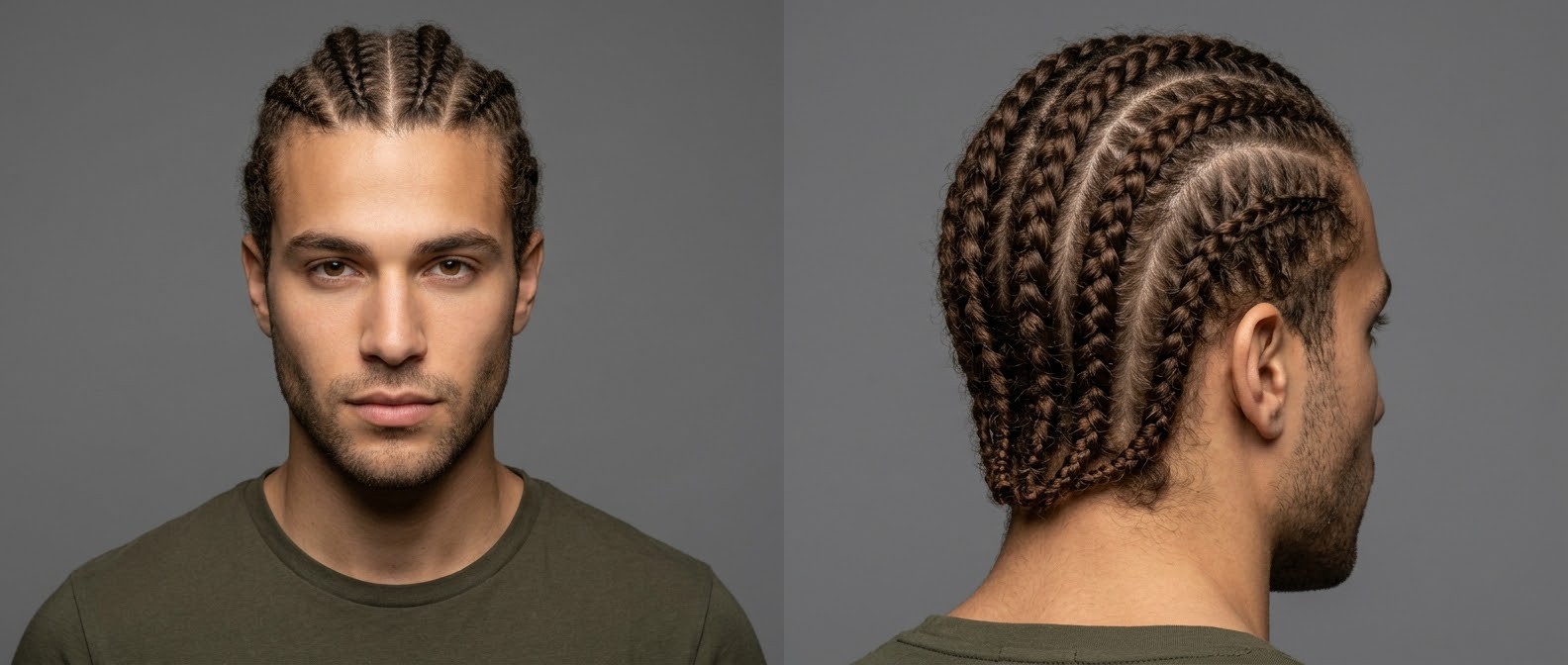
Cornrows
Classic Straight-Back Cornrows with Clean Precision Partings for Thick Hair
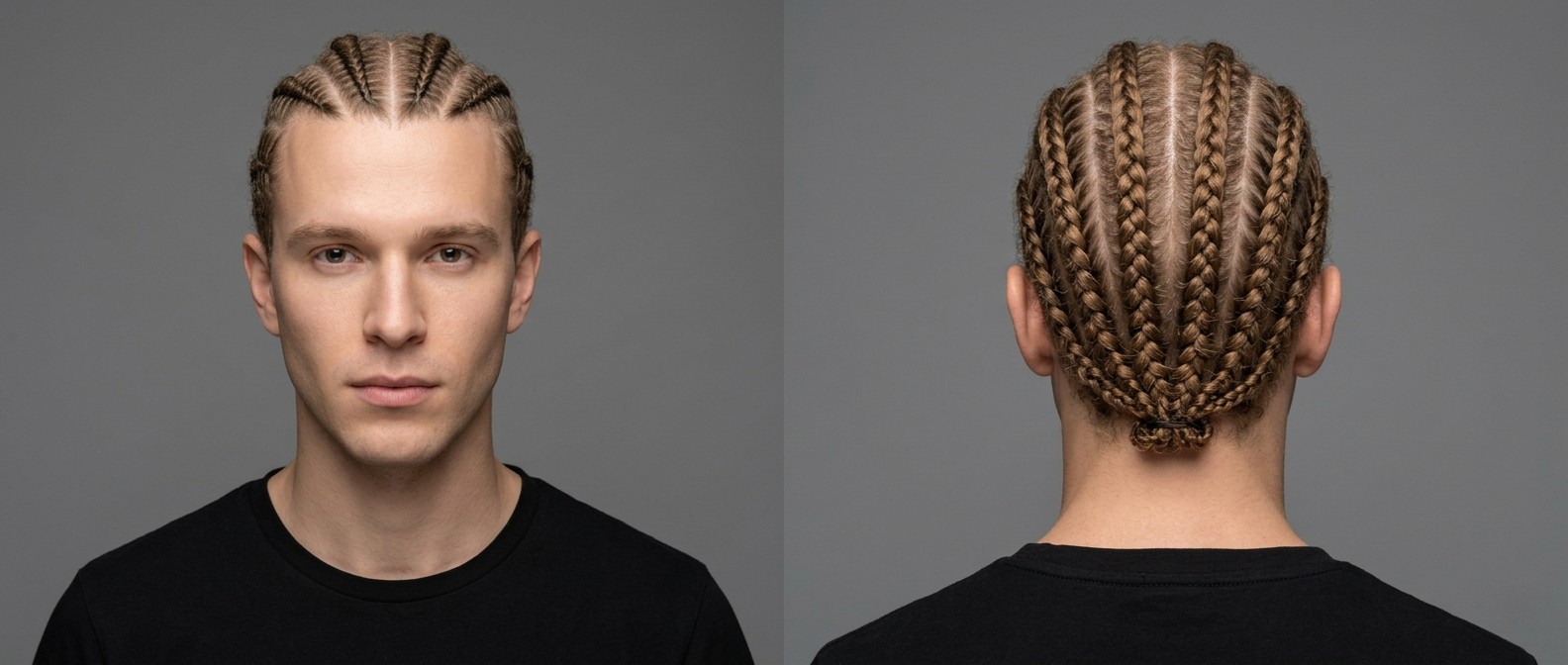
Cornrows
Classic Straight-Back Cornrows with Clean Symmetrical Partings
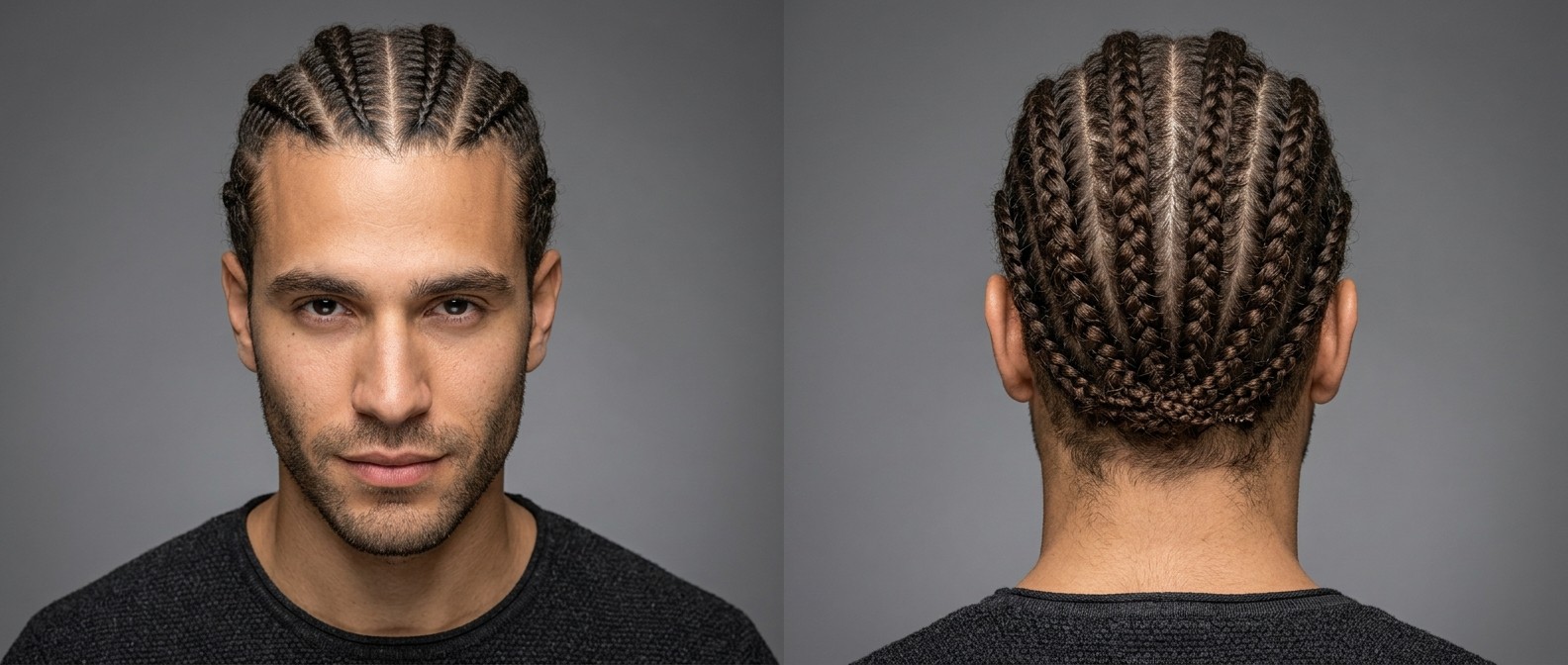
Cornrows
Classic Straight-Back Cornrows with Symmetrical Parting and Tucked Nape
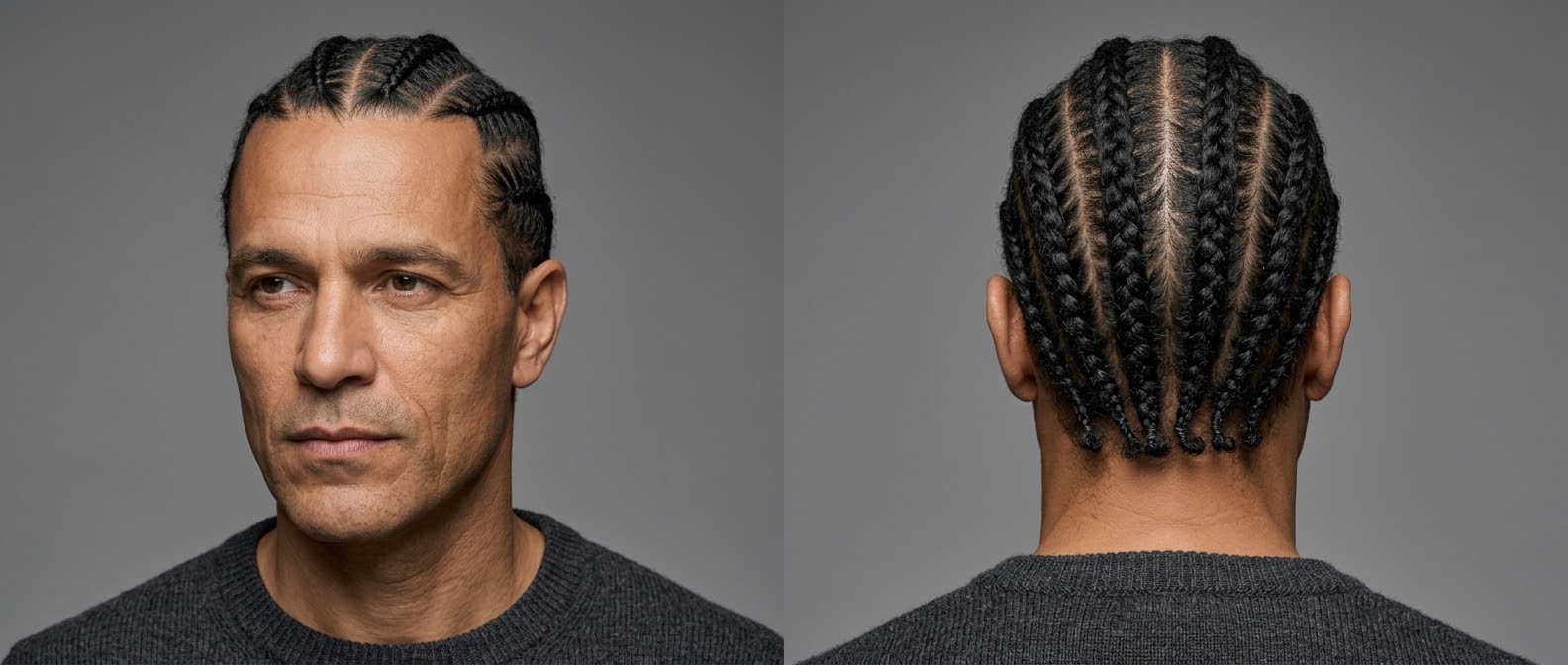
Cornrows
Classic Straight-Back Men's Cornrows for Medium Length Hair
Cornrows
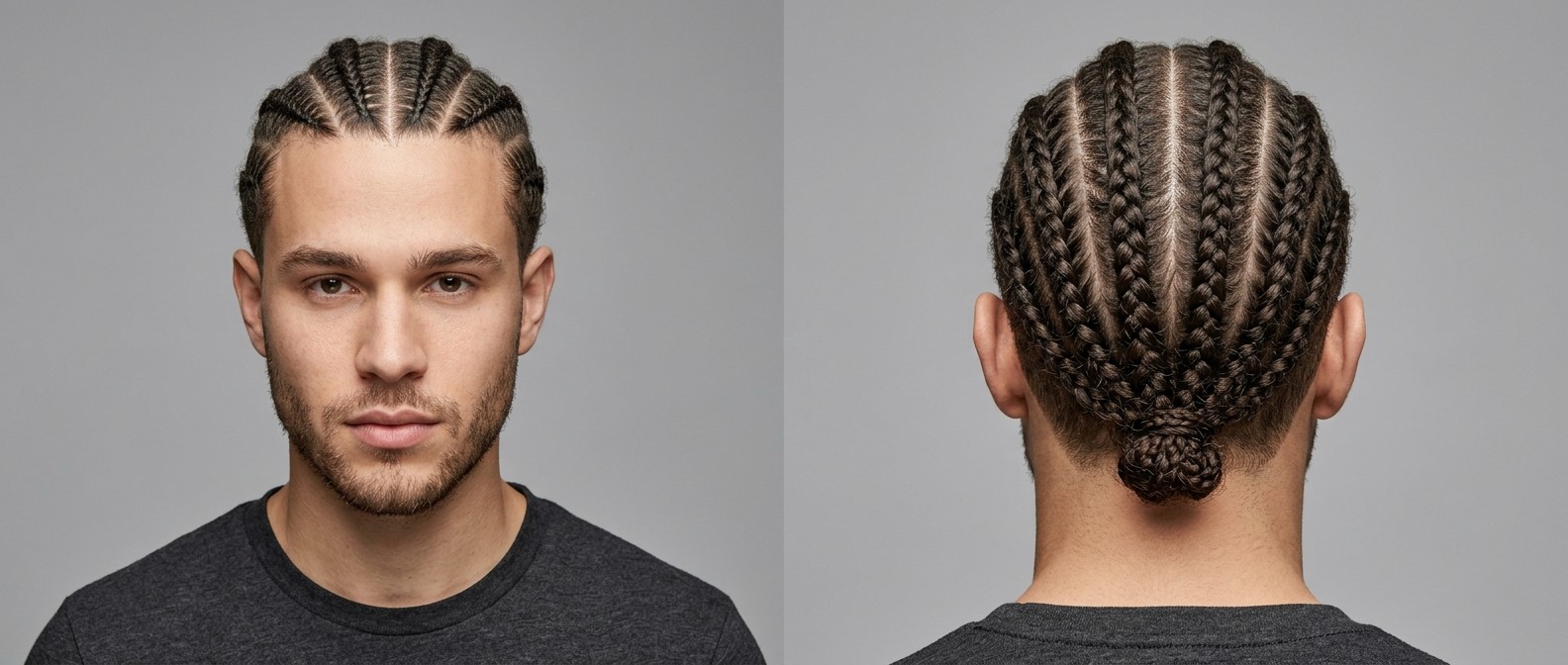
Men's Straight-Back Cornrows with Tucked Nape for Thick Hair
Cornrows